

The Asakawa Centennial at Yale
Asakawa Kan’ichi (1873-1948)
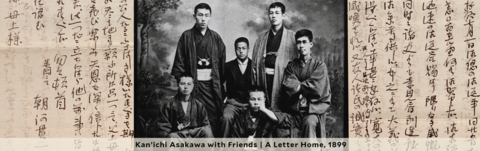
Asakawa Kan’ichi was born in 1873 in Nihonmatsu, Fukushima, Japan, and graduated from Tokyo Senmon Gakko (Waseda University). Asakawa continued his education in the United States and received his B.A. from Dartmouth College in 1899 and his Ph.D. in History from Yale University in 1902. Having seen how little Japan was understood in the United States at the turn of the century, Asakawa decided to dedicate his life to the enhancement of mutual understanding between Japan and the United States. This he did through a lifetime of devotion to scholarship while teaching first at Dartmouth College (1902-1906) and then at Yale University from 1907 to 1942.
Dr. Asakawa’s scholarship as a pioneering institutional historian of Japan and a comparative historian became widely known through such works as The Early Institutional Life of Japan: A Study in the Reform of 645 A.D. (1903 and 1963), The Documents of Iriki (1929 and 1935), and The Land and Society in Medieval Japan (1965).
Dr. Asakawa also served the Yale University Library as curator of the East Asian Collection from 1907 to 1948. While on a trip to Japan in 1906-1907, he acquired 8,120 titles in 21,520 volumes of Japanese library materials for Yale University as well as 3,160 titles in 45,000 volumes of similar materials for the Library of Congress, thereby building the foundation for Japanese research collections at both institutions.
Another dimension of Dr. Asakawa’s contributions may be seen through his involvement in current affairs. During and after the Russo-Japanese War of 1904-1905, he was actively engaged in an effort to explain to the American public the international situation in East Asia through numerous speaking engagements and articles in both scholarly and popular journals. For example, he published The Russo-Japanese Conflict: Its Causes and Issues (1904) and Nihon no Kaki (Crisis for Japan, 1909). Through the years he continued to carry on an astounding volume of correspondence with many leading Japanese in literary, political, and scholarly circles, as well as with his many friends in the United States. He never ceased to speak his conscience; he judged the two countries he loved, Japan and the United States, by the highest of moral standards, as he conducted his own life.
Dr. Asakawa’s last venture in the field of personal diplomacy was an attempt to help prevent the outbreak of World War II in the Pacific. Joining with Dr. Langdon Warner, a noted Japanese art specialist at Harvard University, he drafted an appeal to the Emperor of Japan which he hoped President Franklin Roosevelt would send under his signature. Warner spent two days in late November of 1941 presenting the Asakawa Draft through a number of channels in Washington, while the President was in Warm Springs, Georgia. President Roosevelt did send a letter; but, by the time it finally reached the Emperor, Japanese warplanes had already taken off on their way to Pearl Harbor.
When Asakawa subsequently found himself an enemy alien overnight, President Charles Seymour of Yale University sent him the following hand written note, dated December 8, 1941:
“I can understand how painful these days must be for you and I write merely to tell you of my understanding and to assure you of my intense desire to do all that I can to make them a little easier. You can count upon the appreciative affection of your friends. All that lies in the power of the university will be done to keep your external life normal; anything that any one of us can do to ease the spiritual load you carry or shall want to do. Yale can never repay with any adequacy your service to her and to scholarship.”
Dr. Asakawa was known in Western academic circles as a world class historian. In recent years, he has also become popularly recognized in Japan through the publication of a monographic biography and a series of research articles on his life and scholarship, as well as a massive collection of his letters.
The Japan & Yale Twenty-First Century Initiative has been developed as part of the centenary celebration in 2007 of the appointment of Professor Kan’ichi Asakawa (1873-1948) to the faculty of Yale University in 1907. The initiative aims to promote exchange between Yale and Japan while keeping in mind the legacy of Japan-U.S. relations established at Yale during the tenure of Professor Kan’ichi Asakawa in the 1930s and 1940s.
JAPAN AND THE WORLD CONFERENCE
From March 9-10, 2007, the Council on East Asian Studies will co-sponsor an international conference at Yale University with the Japan Foundation Center for Global Partnership entitled Japan and the World: Domestic Politics and How the World Looks to Japan. The conference will take place at Henry R. Luce Hall, 34 Hillhouse Avenue, New Haven, CT and is in honor of the memory and legacy of Asakawa Kan’ichi.
After a century and a half as the dominant power in Asia, Japan is once again confronting a tectonic shift in Asia’s geopolitical landscape. Nothing looms larger in Japan’s foreign policy than China’s rising power, but China’s power appears to Japan as Janus-faced: China’s economic dynamism draws in colossal quantities of Japanese investment and production, locking the two countries in closer economic interdependence than ever before and fueling Japanese economic growth. At the same time, China’s economic growth is financing an enormous military build-up. This conference convenes a high-profile group of scholars and practitioners to consider Japan’s new geo-political environment, and to assess the domestic political process that presents policy options to the voting public. To view a complete schedule for the conference in PDF format, please CLICK HERE.
The DEADLINE TO REGISTER for the Japan and the World Conference is Saturday, March 3, 2007.
To REGISTER for the Conference, please contact anne.letterman@yale.edu and provide your name, institutional affiliation, mailing address, and the specific conference sessions you plan to attend.
ASAKAWA GARDEN PROJECT
The Asakawa Garden Project at Yale University has been established to recognize the achievements and legacy of Professor Asakawa. Plans for the creation of a garden on the campus of Yale University are currently in development and fundraising for the project is now under way. For more information on this important project, please CLICK HERE. To view the architectural plans for the garden site, please CLICK HERE.
KOMONJO/KUZUSHIJI WORKSHOP
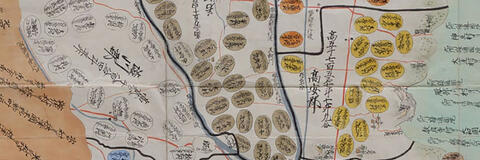
Just prior to taking up his positions in the Yale History Department and Library in 1907, Asakawa Kan’ichi spent 18 months in Japan acquiring materials for Yale and also the Library of Congress. The maps, books, scrolls, manuscripts, and other materials that he purchased, received as donations, or had copied for Yale by specially trained scribes, formed the nucleus of the Japanese collection at Yale. In addition, Asakawa was instrumental in the selection and donation of another important group of rare Japanese works, the Yale Association of Japan Collection, which was acquired in the 1930s. Works from these two collections will be featured in a summer 2007 workshop at Yale for the study of Japanese paleography, the Komonjo/Kuzushiji Workshop. For further information, please CLICK HERE.
Return
to Council on East Asian Studies at Yale University - Special Projects and
Initatives